REVIEW: Vivo Performing Arts presents ‘What Makes it Great?’ with Rob Kapilow highlights the brilliance of Broadway’s Lerner and Loewe

What elements contribute to a great song?

On a grand piano alongside a trio of talented singers at center stage, NPR’s popular composer, conductor, and master music analyst Rob Kapilow continues his 27th year captivating audiences with his vast musical knowledge, sense of humor, and careful analysis of what makes the best songs tick.  Every note, lyric, and rhythm is meticulously constructed to bring out the excitement and enrich the scope of the piece and Rob Kapilow shows you just how they do it.  Though music styles and genres inevitably change, Rob Kapilow may make you see your favorite songs in a whole new light.

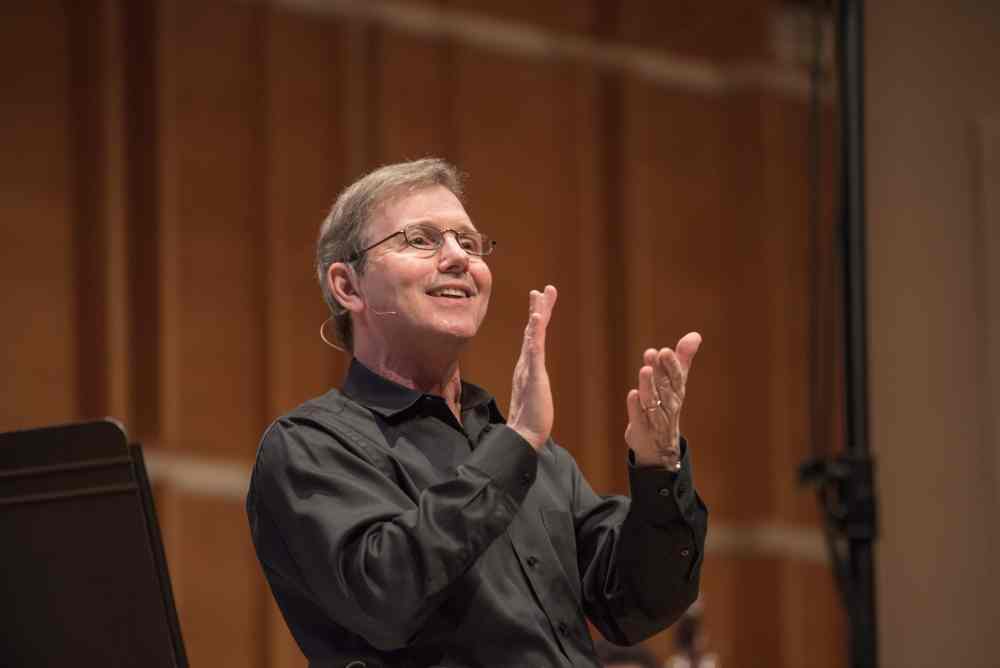
Rob Kapilow as Vivo Performing Arts presents ‘What Makes It Great’ Credit Robert Torres

Vivo Performing Arts, formally Celebrity Series of Boston, presented What Makes it Great? with Rob Kapilow live and in person at New England Conservatory’s Jordan Hall in Boston, Massachusetts for one night only Saturday, January 17 at 8PM.  This semi-interactive performance ran 90 minutes and included a short question and answer session.  Click here for more information on the performance and here for a closer look at Vivo Performing Arts’ upcoming events. Click here to learn about all of Rob Kapilow’s works including his next stop in his What Makes it Great series.


Whether you are music virtuosos or a casual music listener, Kapilow consistently offers something new that in some way will change the way you hear music for the better.  Though often speaking to a large audience, Rob Kapilow is so personal, relaxed and friendly during his talks, it often feels like a one-on-one session on a baby grand piano.  He is so popular with the Vivo Performing Arts crowd, he offers at least two appearances a season tackling everything from swing to dance to classical to Broadway music revealing each song’s inherent brilliance.

Rob Kapilow, Emily Albrink and Ben Jones in Vivo Performing Arts Presents ‘What Makes it Great’ Credit Robert Torres

Featuring a few of American lyricist and librettist Alan Jay Lerner and Austrian composer Frederick Loewe’s classic Broadway songs from Camelot, My Fair Lady and Brigadoon, Kapilow uses a mix of sophistication, humor and an easy to follow delivery to explore each song’s appeal and emotional undertones through its carefully selected musical notes. 

Delving into the Golden Age of Broadway as well as Lerner and Loewe’s dynamic history, Kapilow chose a selection of lighthearted and dreamy songs as well as pivotal numbers from musicals that leads to a character’s imminent transformation.  With humor and grace, Kapilow also reveals what each song might have sounded like without its individuality and as he peels back each layer, What Makes It Great? becomes an eye-opening experience. 

Calling on a couple of Broadway love songs, Kapilow was accompanied by soprano Emily Albrink and stirring singer, actor, and musician Ben Jones.  Jones and Albrink share gorgeous harmony and lighthearted chemistry for duets Brigadoon’s Almost Like Being in Love and playful Heather on the Hill.

Rob Kapilow, Ben Jones, and Emily Albrink as Vivo Performing Arts

Touching upon Rex Harrison’s complex casting in My Fair Lady, Kapilow ties in music and lyrics which waltz together teetering on so many emotions for I’ve Grown Accustomed to Her Face in which Jones articulates in an animated and humorous rendition.

Rob Kapilow, Emily Albrink and Hayden Lockhart as Vivio Performing Arts presents ‘What Makes it Great’ Credit Robert Torres

In an elegant flowing dress, Albrink brimmed with excitement evident is her full and rich vibrato as she delivered an exuberant rendition of My Fair Lady’s I Could Have Danced All Night.  In a jacket, tie, and bathed in rose lighting, Jones croons, mastering the complex and emotional weight of Camelot’s stirring ballad If Ever I Should Leave You, before concluding with a bold finish. 

Rob Kapilow, Emily Albrink, and Ben Jones as Vivo Performing Arts presents ‘What Makes it Great’ Credit Robert Torres

From classic songs and American Standards such as It’s Almost like Being in Love from Brigadoon to the high-spirited I Could Have Danced All Night from  My Fair Lady to a humorous and not to be missed I Remember it Well from Gigi, Rob shows how compulsive American lyricist Lerner of the famed retail stores and poverty-raised and frugal Austrian composer Loewe poured themselves and their imaginations into their music to create some real Broadway magic.

Vivo Performing Arts, formally Celebrity Series of Boston, presented What Makes it Great? with Rob Kapilow live and in person at New England Conservatory’s Jordan Hall in Boston, Massachusetts for one night only Saturday, January 17 at 8PM.  Click here for more information on the performance and here for a closer look at Vivo Performing Arts’ upcoming events. Click here to learn about all of Rob Kapilow’s works including his next stop in his What Makes it Great series.

REVIEW:  Accompanied by A Far Cry, NPR’s Rob Kapilow made an enthusiastic return to Boston with an American classic for Celebrity Series of Boston’s ‘What Makes it Great’ series

Though NPR’s famous composer, conductor, author, and music commentator Rob Kapilow has unveiled quite a few eye catching music details over the years with Celebrity Series of Boston from Swing to Broadway to carols and much more, perhaps the most interesting takeaway from Aaron Copland’s classical music composition Appalachian Spring is that it is not about Appalachia nor is it about spring. 

Making his return to NEC’s golden and gleaming Jordan Hall in person for the first time in front of an audience since the pandemic, NPR’s Rob Kapilow covered some fascinating music territory in What Makes it Great? with Rob Kapilow and a Far Cry Inventing America Part 2 Copland’s Appalachian Spring: An American Voice for Classical Music on Sunday, February 5 at Jordan Hall in Boston, Massachusetts. The show ran for 120 minutes with a 15 minute intermission. Click here for more information on Rob, here for more on A Far Cry, and here for more information about Celebrity Series of Boston.

Rob Kapilow Photo Credit: John Johansen

Kapilow guided the audience through Aaron Copland’s Appalachian Spring with greater technical zeal and an interactive approach than he has in some of his past performances.  Part teacher, humorist, and historian, Rob Kapilow has been performing the What Makes It Great series for approximately 15 years, expertly uncovering a new way to connect to a vast array of music and encouraging the listener to experience this music in an entirely new way from technical composition to its emotional impact.

As beautiful and fanciful as Appalachian Spring sounds, it is neither about Appalachia nor spring and was entirely imagined by Copland who was a Jewish immigrant from Brooklyn.  What is so wondrous about this 40s piece is how Copland creates this imaginary and extraordinary world, a piece which was originally called House of Victory, and how it has been historically associated with America over the years.  Kapilow uses a bit of a different approach for this particular work by expounding on  the technical  and mechanical side of the piece and inviting the audience to actively participate in the song’s musical patterns and rhythms.  Appalachian Spring is also associated with lyrics and it is a based on the Shaker melody, Simple Gifts, and Rob spends a wealth of time on the mechanics of the piece and how it ties together.  It is a method that would thrill classical music fans, music enthusiasts, and musicians alike.  He even exposes the subtle intricacies of Copland’s inherent confidence, style, and how to identify it in Copland’s other works.

Grammy-nominated Chamber Orchestra A Far Cry Photo courtesy of A Far Cry

Adorned in suits, ties, and gowns, Grammy nominated and self-conducted chamber orchestra A Far Cry worked seamlessly with Kapilow as he broke down each aspect of the piece, a feat not easy to do with Kapilow’s specific stops and starts.  A Far Cry has made its way around the world since they started in 2007 and what sets this orchestra apart from others is the open communication between each musician. A Far Cry reflected just how important it is to remain in sync with the group, especially since they must connect without a conductor.  Their camaraderie and chemistry as they play is compelling to witness as they direct each other with each note.

Copland’s Appalachian Spring has a unique zest, playfulness and peppy thrill of nature through harp and chime as well as calm with a western tinge as Rob explains its historical significance and just why the piece is so enjoyable through each note’s placement, rest, and orchestration. 

Appalachian Spring was a childhood favorite for Kapilow’s which was perfectly clear through his personal and humorous anecdotes and the natural and engaging enthusiasm he exhibited throughout the production.  Rob is always teaching something new to even some of the most trained and learned music enthusiasts.  It was easy to see he has missed the live audience and judging from the audience’s resounding applause and standing ovation, they have missed him too. 

Celebrity Series of Boston continues its digital and in person season which includes Jason Moran and the Big Bandwagon on February 17, Dreamers Circus on February 24, Aoife Donovan on March 17, and David Sedaris on April 2, and the return of Alvin Ailey on May 4. Click here to see Sleepless Critic’s past review of Dreamers Circus.  Click here to see the full list of Celebrity Series of Boston’s upcoming events.

REVIEW: Featuring Grammy award-winning mezzo-soprano Krista River and special guest musicians, A Far Cry ended season with a stirring ‘Sunset’

Having witnessed A Far Cry’s triumphant return to performing live and in person last September as they kicked off their 15th season with Circle of Life, it was an honor and fitting to review Sunset, A Far Cry’s final concert of the season.  Sunset was originally scheduled for March 2020 and this Grammy-nominated, self-directed chamber orchestra was thrilled to finally present it onstage.  With a heartfelt introduction by Sarah Darling, Boston-based A Far Cry brought a diverse repertoire of suspense, tragedy, and soaring vocals by mezzo-soprano Krista River before joining a collection of promising musicians including Project STEP for a robust finale.

A Far Cry criers at Jordan Hall Boston MA Photo credit to A Far Cry

Following opening group Project STEP, A Far Cry took the gorgeous Jordan Hall stage in Boston, MA for their final concert on Friday, May 13 for 90 minutes with no intermission.  A Far Cry will cap off their 15th season with a Spring Soiree on June 1 at the Nathaniel Allen Center for Arts and Culture in Newton, MA.  The event includes a sneak peek of next season, outdoor cocktails, hors d’oeuvres, and a charity auction with the option to attend in person or virtually.  Click here for more information and here for a look at A Far Cry’s upcoming season.

Grammy-nominated Chamber Orchestra A Far Cry Photo courtesy of A Far Cry

Elegantly dressed in flowing dresses and suits, A Far Cry opened their final concert with all 18 criers for Julius Eastman’s Joy Boy.  A piece likened to the feeling of falling in love, Joy Boy has a trickling and mounting intensity as the orchestra gradually comes to life.  It is fascinating to watch the ebb and flow in Joy Boy’s soothing opening rhythms which escalate to a gripping crescendo before lulling into its resonating finale.

Imagine moments before a stunning discovery in a suspenseful film.  That’s the escalating tension built around Lutoslawski’s fiery Musique Funebre, Spanish for Funeral Music.  A Far Cry performs this chilling and somber dirge with rich, Hitchcockian flair enhanced by a stroke of the viola and plucking, creeping rhythms.  Fueled by searing drama and violin-tinged, pulsing urgency, A Far Cry plays furiously to bring this masterful work to an exciting and astounding climax that might leave you with a few goose bumps by the finale.

‘Il Tramonto Photo credit to Sarah Darling/A Far Cry

Led by Grammy award-winning mezzo-soprano Krista River’s airy and soaring vocals, A Far Cry took on Respighi’s classic piece, Il Tramonto, which is an Italian phrase translated as The Sunset.  It is a popular piece having been featured in films such as the western classic, The Good the Bad and the Ugly.  Adorned in a shimmering blue gray gown with her hair swept into an updo, River’s expressive vocals and her stirring countenance brings out the surreal poignancy of this tragic romance.  Based on a poem by Percy Bysshe Shelley, Il Tramonto has a moving story behind it and possibly inspired by a real life disaster in Indonesia. 

Mezzo-soprano Krista River Photo credit to A Far Cry

A Far Cry recalled how music has been “cathartic journey” and like many in the arts and beyond, the love for the arts has been tested, especially in the last few years.  Joined by promising musicians in New England Conservatory, NEC Prep, and Project STEP, A Far Cry brought this concert to a robust and wondrous close with Vicente Lusitano’s Aspice Domine and Ralph Vaughan Williams’s Fantasia on a Theme, the latter dedicated to an inspiring teacher that encouraged young musicians to pursue their musical aspirations.  Highlighted by a duo of skilled violinists, this group of musicians brought A Far Cry’s 15th season to a glorious close with a mix of fragility, power, and a stirring finale.

Students in Project STEP Photo credit to Project STEP/A Far Cry

A Far Cry will cap off their 15th season with a Spring Soiree on June 1 at the Nathaniel Allen Center for Arts and Culture in Newton, MA.  The event includes a sneak peek of next season, outdoor cocktails, hors d’oeuvres, and a charity auction with the option to attend in person or virtually.  Click here for more information and here for a look at A Far Cry’s upcoming season.

Exploring theatre, nature, space and more, Boston Landmarks Orchestra’s Christopher Wilkins talks depth and diversity in free summer concert series

From exploring live theatre and music to nature to science to space as well as taking on racism, climate change, and many more important topics all involving a vast array of community members, organizations, and performers, Boston Landmarks Orchestra is so much more than a beautiful free Wednesday night concert outing at the Esplanade.  Boston Landmarks Orchestra Gala will celebrate 90 years of free concerts on the Esplanade in October.

WCRB is a media partner for the Boston Landmarks free concert series.  Click here for Boston Landmarks Orchestra’s complete summer schedule at Boston’s renowned Hatch Shell and here for further details on the upcoming Gala.

It was an honor to speak with Christopher Wilkins, Boston Landmarks Orchestra’s conductor and Music Director, who took time out of his busy schedule to discuss the highlights of the Boston Landmarks Orchestra’s summer season and what is coming up.

The Sleepless Critic:  The season kicked off on July 10 with the second annual “Season Tune-Up” party.  What was that like?

Christopher Wilkins:  It was a gorgeous night with a great turn out.  Lots of children attended and we introduced our audience to many of our partner organizations which include musical organizations, music educational schools, and partners like the New England Aquarium and the Museum of Science.  The “Season Tune-Up” Party featured fun games, a performance from the Everett High School band, and our Maestro Zone where kids can step up at the podium, wave the baton, look at a score, and get a conducting lesson.  We offer Maestro Zone at our regular concerts as well.

Boston Landmarks Orchestra Maestro Zone Assistant Conductor Shuang Fan

The Maestro Zone with Maestro Zone Assistant Conductor Shuang Fan

SC:  We’ve been blessed with some beautiful nights this summer.  You have been the Music Director and conductor for the Boston Landmarks Orchestra since 2011.  What has it been like for you collaborating with different theatres and new works each year?

CW:  Our mission is to engage as many Bostonians as possible from all walks of life and one of our strategies is to develop partnerships.  They feature an array of organizations to get their fans, their folks, and their constituency excited to come to a concert and work with us.

One of our best strategies is to create composer residencies in different neighborhoods around Boston so people who might not ever encounter an orchestra can develop some way of making music or dancing or some other performing art that they can bring to our stage and perform with the orchestra. We have a lot of inexperienced young performers throughout the summer and some who have never been onstage before.   We do all that along with an eclectic lineup of Dvorak, Broadway, symphonies, and a great choral repertoire.

SC:  It must be an incredible experience to see how everybody interacts with each other and how it turns out onstage.

CW:  It’s wonderful to perform it in the Hatch Shell because it is an iconic venue, people associate it with orchestral music, and it is in the heart of the city.  The Hatch Shell is also quite enormous. We can fit 5,000 people or more at our concerts and that is typically what we draw when the weather is nice.

SC:  Such depth in a free event.

CW:  It’s important to many people that can’t afford to come otherwise.  It’s also a powerful emblem of the idea of universal access.  Everybody is welcome.

We just think about access barriers, which are not only economic.  Cultural assumptions in a community can cause people to stay away.  At Landmarks, we think deeply about what those barriers are and do what we can to get rid of them.

SC:  Yes, and you have held many events so far this season.  For example, you recently celebrated the 50th anniversary of the Moon Landing with Symphonic Space Odyssey.  How did you pay tribute to this historic event?

CW:  We performed that in Jordan Hall because it was a stormy night.  Jordan Hall is one of the most beautiful venues in America and the sound indoors just rattles your bones.  We didn’t have to change the program at all, just the venue.

The Moon Landing is one of the most amazing achievements in the history of mankind.  It was an awesome night and we celebrated it with the Museum of Science which was perfect because they have had an exhibition ever since the moon landing occurred.  The Museum of Science prepared fabulous video footage relating to the moon landing, space travel, rockets, and deep space taken from materials produced in house at the Hayden Planetarium for their full dome experience.

SC:  What are you most looking forward to this season?

CW:  Each week is so over the top that it’s hard to pick a favorite.  We have a wonderful collaboration on August 14 with the New England Aquarium featuring some remarkable video material that will be synchronized live to the orchestra.

Boston Landmarks Orchestra New England Aquarium

Boston Landmarks Orchestra partners with the New England Aquarium for a free concert on August 14 Photo courtesy of Boston Landmarks Orchestra/New England Aquarium

The subject is climate change and we’re performing Vaughan Williams Symphonia Antarctica which is originally a film score, but now set to a more recent film made by Natural History New Zealand featuring all shots from Antarctica.

Then we have a beautiful photographic sequence put together by Boston Globe writer David Arnold called “Above and Below.”  He’s taken Brad Washburn’s iconic aerial photographs of glaciers and coral reefs mostly from the 1930’s and then taking the same shots today.  Of course what you see is a devastating record of loss set to Adagio for Strings.  The program also includes optimistic shots from Boston Harbor and other places from then and now which shows tremendous improvement environmentally and send the message that we can do something about climate change.

We did an extremely interesting panel discussion recently which has some caused useful and in depth panel conversation called “Who Should Sing Ol’ Man River?” around race and the portrayal of racial themes at WBUR CitySpace.  Our moderator was Emmett G Price III, a celebrity in Boston and a wonderful musician, historian, pastor, and radio personality.  It was a wonderfully experienced and informed panel who weighed in on a lot of these questions and shaped how we put together the following week’s concert.

Boston Landmarks Orchestra Alvy Powell

Bass Bariton Alvy Powell Photo courtesy of Boston Landmarks Orchestra

SC:  Ol’ Man River from Rodgers and Hammerstein’s “Showboat” is such an amazing song and I’ve seen it done is so many different ways.

CW:  It’s a showstopper.  Our base Alvy Powell has sung Ol’ Man River in the White House for the last six sitting Presidents in a row.  He sang it at George H.W. Bush’s funeral at President Bush and his wife Barbara’s request.  He also sang it at Gerald Ford’s funeral.  If anyone should sing Ol’ Man River, it’s Alvy Powell and he performed it that night.

SC:  What kind of conversation sprung from that panel?

CW:  That’s a good question.  We got into questions of language, dialect, the history of black music, and cultural appropriation.  Quite an interesting segment was when we were looking at where we go from here.  One of our panelists was Ashleigh Gordon, founder of an organization that has attracted a lot of praise and attention called Castle of Our Skins.  It celebrates African American composers and performers.  She’s done an amazing job furthering the discussion and coming up with creative ways of producing eye catching programming.

They are opening a permanent set of offices at the Boston Center for the Arts.  We are collaborating with Ashleigh, Castle of Our Skins and Anthony Green, a composer she works with frequently on the Esplanade on August 21 for our Landmarks Dance Night.  The project surrounds the music and dance of Haiti because we are also including the Jean Appolon Expressions Dance Company.

Boston Landmarks Orchestra Jennifer Ellis Matthew DiBattista, Maesto Wilkins, and One City Choir

Christopher Wilkins with Jennifer Ellis Matthew DiBattista, Maesto Wilkins, and One City Choir Photo courtesy of Boston Landmarks Orchestra

It’s often our best vehicle for showcasing the diversity of traditions and types of cultural expression.  I grew up here, but the city is infinitely more diverse now than it was when I grew up.

SC:  Absolutely.  What have you liked most over your time with the Boston Landmarks Orchestra?

CW:  We’ve had lots of great moments over the last eight or nine years.  My first concert was conducting Beethoven’s 9th at Fenway Park so that is pretty hard to top.  We did an amazing night celebrating the 50th anniversary of Martin Luther King’s I Have a Dream Speech with Governor Deval Patrick as our narrator and featuring a lot of video and photographic imagery.

We did a memorable collaboration with the Isabella Stewart Gardner Museum when their director, Peggy Fogelman, first arrived in Boston.  Another highlight was a series of programs with Commonwealth Shakespeare Company.  We performed full productions of musicals or a Shakespeare play such as “Midsummer Night’s Dream” with Mendelssohn.

The musicians learn something they know so well and are able to put it into the context of the play while the actors now can play off a symphony.  Now how often does that happen?   It is amazing for the performers and the audience.

SC:  You’ve performed all over the United States.  What do you like best about your time with the Boston Landmarks Orchestra?

CW:  I love our mission.  It’s readily understandable to most people in the community which I think is why we are receiving increasing levels of support from all quarters from individuals and foundations and from political reps because we are using great music with its level of complexity, depth, and emotional appeal and a first class professional orchestra as a means to gather community together.

I don’t know another orchestra that has a mission defined in this way.  I learn a lot and meet all kinds of interesting people doing interesting work.  We get to come together in a musical setting and it’s almost guaranteed everybody has a wonderful time.

Sit back and enjoy the Boston Landmarks Orchestra free every Wednesday night.  Click here for the full schedule and how to support future concerts.


Laurence Lesser shares music memories as New England Conservatory celebrates his 80th birthday and Leonard Bernstein’s centennial in free opening concert

‘You don’t choose music.  It chooses you.’  This is just one of renowned cellist and longtime New England Conservatory (NEC) President Emeritus Laurence Lesser’s thoughts on music as Lesser celebrates his 80th birthday in a big way with the New England Conservatory Philharmonic and acclaimed conductor Hugh Wolff on Wednesday, September 26 at 7:30 p.m.

Taking place at NEC’s Jordan Hall in Boston, Massachusetts, this free concert also pays tribute to Boston native, legendary composer, and NEC Prep alumnus Leonard Bernstein’s centennial with Symphonic Dances from West Side Story and much more.  Click here for more information and how to reserve seats to this extraordinary concert.

NEC’s Laurence Lesser, who will be performing at the concert, discusses his history with music, the cello, career surprises, and recording Hollywood soundtracks from films such as Rosemary’s Baby.

Sleepless Critic:  I understand you were invited to perform with the New England Conservatory Philharmonic and conductor Hugh Wolff for your 80th birthday celebration.  Were you able to choose your own music?

Laurence Lesser:  I asked to do Ernest Bloch’s  Schelomo because it is a wonderful piece full of personal meaning for me.

SC:  What first interested you in music, especially the cello?

LL:  My parents took me to LA Phil Children’s concerts when I was about 5.  I wanted to play the double bass, but they thought that was too big for a little guy and gave me a cello for my 6th birthday.

SC:  I understand you play a 1622 Italian-made cello.  There must be an amazing story behind how you obtained it.

LL:  I was looking for a great old Italian cello with a true solo voice and bigger dimension than what I was using.  I saw it in a shop in London, England, but I was second in line for it.  Fortunately very soon afterwards in 1972, it came my way.

Leonard Lesser

Photo credit to Carlin Ma Photography

SC:  What was it that encouraged you to pursue music as a career?

LL:  My mother was a pianist.  My two older brothers and I had music lessons from an early age.  When I went to college at Harvard to study mathematics, I soon knew that mathematics was the wrong path for me and it had to be music.  You don’t choose music, it chooses you.

SC:  Music afforded you a great deal of opportunities, just a couple of them recording Hollywood soundtracks such as Rosemary’s Baby and Finian’s Rainbow and traveling the world.  What kind of surprise opportunities have you experienced in your career or a moment where you couldn’t believe this is happening to you?

LL:  I played in chamber music concerts with Jascha Heifetz and my teacher Gregor Piatigorsky and we performed at Carnegie Hall.  Such a wonderful place and an amazing memory to be on stage with those musical giants!

SC:  How did you end up working at the New England Conservatory?  I understand during your tenure as President, you were part of the restoration of Jordan Hall and you curated ‘First Mondays at Jordan Hall.’  Please tell me about that.

LL:  I was invited to teach there by then President, Gunther Schuller.  Jordan Hall is one of the greatest ‘rooms’ for music in the world.  It had become shabby.  When I was President, my team joined me in focusing on the restoration.  ‘First Monday’ concerts were the outgrowth of ad hoc faculty chamber concerts.  I decided to put some structure into it and it’s now beginning its 34th season!

SC:  Congratulations!  Jordan Hall is a majestic venue.  You’ve enjoyed a wonderful career in music from teaching to performing.  What kind of music do you like to listen to?

LL:  I can listen to anything that ‘speaks’ to me.  Any medium suits me and I don’t simply listen to pieces I have heard over and over again.

SC:  What music goals are you pursuing now?

LL:  I think it’s too late in my life to go on a completely new road, but I intend to keep pursuing excellence in what I am currently doing.

SC:  For those pursing music as a career, what was the best piece of advice you were given?

LL:  My father, who was not a musician, said you should do what you love in life.  It’s not for personal glory or ego.  Simply keep remembering that you are doing this for listeners who want something.

Attend Leonard Lesser’s 80th birthday and celebrate the music of Leonard Bernstein on Wednesday, September 26 at 7:30 p.m.  New England Conservatory will pay tribute to Leonard Bernstein’s works all season, including the New England premiere of the exhibition, Leonard Bernstein at 100, unveiling on September 24 and continuing through November 11 at NEC’s Student and Performance Center.  Click here to learn how to support NEC and here for all of NEC’s upcoming concerts this season.