Get to know Sam Brewer, GBH’s newly appointed General Manager of Music

Music is the foundation for so many amazing aspects of life.

As GBH’s newly appointed Head of Music, Sam Brewer discusses music’s remarkable impact and how he started in the industry.  He also shares where to listen to live concerts around Boston after work for free, insight into GBH’s extraordinary studios, and the revolutionary ways GBH is connecting artists to viewers and listeners.

Sleepless Critic:  Just to clarify, GBH’s Head of Music primarily covers classical and jazz music?

Sam Brewer: Yes, it is the jazz and classical team.  GBH Music is a multi-platform production team housed inside GBH with twelve full time and almost as many part time employees.  Our biggest commitment and what everyone knows us for is CRB Classical 99.5 Boston.  CRB produces over 50 broadcasts a year and we have a live concert every single week from Symphony Hall or Tanglewood.  That includes concerts from the Boston Pops too.

General Manager of GBH Music Sam Brewer Photo by Meredith Nierman/GBH

We also program Jazz on 89.7 FM on the weekends and weekend overnights.  For the past five years, we’ve had a series of about eight GBH Music Presents concerts at the Fraser Performance Studio or Calderwood Studio here at GBH.  In person, streaming, and recorded performances are used on other platforms.  Obviously they stream and may end up as an In Concert production. 

Classical.org is the website for the radio station and a rich source of multimedia content about classical music, social media channels, and two newsletters which is one on jazz and one on classical and so much more.

From the GBH music perspective, we recently launched GBH Jazz Nights which are once a month performances at the GBH Studio at the Boston Public Library in Copley Square.  We’ve teamed up with JazzBoston to present jazz music the second Thursday of every month from 5:30 to 6:30 pm.  It’s a free event and we want to capture people after work to stop by for an hour or two and get a beer and listen to music.  It’s really to raise the profile of everything that we are doing in jazz.  For the past few years we have done these studio jazz shows about four a year and we are looking have four again in the spring.  We’ll have four in the spring to help us build up an audience, the excitement, and the anticipation for that and we feature a great lineup of performers.

Beyond December, we will be looking at a series of jazz performances at Fraser Performance Studio.  Fraser is gorgeous and really the jewel of the production facilities at GBH.  Antonio Oliart is our recording engineer on the GBH Music Team and he had a hand in designing the space and it’s his home along with Téa Mottolese who is our other recording engineer. 

Antonio recorded an album at Fraser with violinist Hilary Hahn which was just named the Gramophone record of the year.  It’s a huge honor and I think he’s won three or four Grammys from records he’s produced in that space.  We host a lot of these GBH jazz and classical music events at Fraser and you’re really sitting with maybe 90 or 100 people in a multi-camera shoot in an acoustically perfect music space. 

Ulysses Quartet perform at an event celebrating the leadership of Tony Rudel, General Manager GBH Music on October 1, 2024 at GBH Headquarters in Brighton, Mass. Photo by Meredith Nierman/GBH

The Boston Symphony Chamber Players came and recorded this beautiful video show in Fraser and then we streamed.  It was in person and it will also become a radio broadcast in a week or two.  Somebody came up to me after the performance and told me they have known this musician their whole life and have never seen this person up close playing like this. 

SC:  Oh, I love those experiences. 

SB: That’s the real benefit of this space.  You get a sort of intimacy with the music that you don’t really get in any other venue in Boston because of the size and how it is structured.  It’s also how we host shows.  Brian McCreath, the host of the BSO broadcasts, hosted this program.  He’s a proxy for the audience and brings the audience into the stories behind the music in such a unique way. 

SC:  We know each other from the Boston Pops.   What piqued your interest from the Boston Pops to make the transition over to GBH?   I know it all starts with classical music. 

SB: That’s a great question.  I was a publicist at the BSO for about 10 years and started at the box office selling tickets.  I was just looking for the next step in my career and there’s such a crossover between the GBH audience and the Boston Symphony audience and in an effort to sort of promote other types of content and other stories, I was drawn to the work in public media and found a happy home for the last six years working quite closely with the newsroom here.  Of course the GBH Music team was my other main client here and pulled it back into the beauty, power and the rich, artistic life of classical music and jazz.  That’s how I found myself working even more closely with the GBH Music Team. 

SC:  You must also find yourself working with some famous musicians.  Which particular person stands out for you that you couldn’t believe you were working with them?

SB: There are countless people, but recently opera bass-baritone Davóne Tines.  We had someone scheduled for the Getting into Opera program and it was a wonderful event open to the public.  We are eventually going to turn it into a series for YouTube.  We’ve done two of these before and we have another one coming up.  We unfortunately lost the soprano who was scheduled to host this master class.  The concept here is people get into opera by seeing how great vocal performances are shaped.  So it’s a master class between a master teacher and a student. 

The star soprano who was supposed to lead the performance had to cancel about 36 hours before.  Davóne Tines came in and I had the opportunity to pick him up in a car and drive him over quickly before the performance was about to begin. 

I was blown away how even at the last minute, he wanted to reshape what we were doing to put the artists in the center and focus on them as humans and people before he got to hear them sing or work with them as a coach.  So, there are countless examples of artists I have met and been star struck or really moved by, but this one recently is just one of the benefits everyone on this team has which are these really close encounters with musicians as people and then get to share their stories with broader audiences.  It’s of interest to any type of consumer of any media, but I think music in particular because it can be abstract and one of things we specialize in is sharing an artist’s story behind the music. 

SC:  How do you think your prior experience has prepared you for what you are doing now?

SB: Two of the trends in my career have been music and communications and I think they will be thoroughly employed in this role.  Being so new to it, I can already tell one of the real joys of this role is working with all the people on this team.  I think anyone in a leadership position is responsible for supporting the team’s work. It is really exciting to come to work every day with people who are ready to pitch new and creative ideas and try to find ways for those little seeds of ideas to grow to support the work of a lot of creative professionals.  So, I suppose having a lot of experience as a communicator, in public relations, and then in public media has put me in a good position to help the team bring all this creativity to the forefront and to find things that resonate with audiences.  I’m excited to see how we can keep growing this incredible foundation here. 

SC:  Music is the connection to everything. 

SB: I agree with you.

SC:  Speaking of which, what is your favorite music and kinds of artists you like to listen to for GBH?

SB: I think from a very early age, I’ve always loved orchestral music.  I will just say broadly classical music encompassing classical, romantic, and baroque.  We play on CRB Classical 99.5 over 500 years of this incredible compendium of artistic styles.  It’s just so easy to get deeply lost in it and imagine your own stories. 

It’s funny because I have certainly listened to all sorts of music.  My wife and I went to the Weezer concert in Boston.  It was great fun, but I also had this experience where we were all the way up in the nosebleed section.  I don’t know what the capacity of TD Garden about 20,000 and it was a wonderful performance and I was thinking if I can just get one percent of these people to turn on CRB and find this intentional listening experience in the genres we promote, I think everyone would grow so tremendously.  A lot of what we program on this station is intentional to capture people who find a familiar sound in what we do and discover that they like classical music.  For example, Renaissance pieces that would be four minutes long and to someone who is just tuning in, it could sound like a folk song.  There could be an energy to Telemann perfect for driving down the road.  I’ve always loved orchestral music. The challenges and the fun of this role is to just to find people in this vast swath of people and find out who might want to come and join us and be part of this tribe. 

SC:  Classical is the foundation of so many other genres of music.  The epic Clair de Lune is a famous classical piece you know that you don’t know that you know.

SB: I agree with you and I think there is also a willingness that there wasn’t ten or fifteen years ago to cross between genres and like what they hear without knowing what the label is.  I just find there is a tremendous opportunity to turn more people into classical music and such growth potential there.   I’m glad we’re focused on that central part of it and our goal is just to spread that out and make people fall in love with it.

One of CRB’s next events will be the GBH Music Holiday Spectacular taking place at Calderwood Studio.  Be the first to learn about GBH’s upcoming music events through classical newsletter The Note and GBH’s Jazz newsletter. 

Know before you go: fun facts and behind the scenes interview at ‘Cirque du Soleil: OVO’

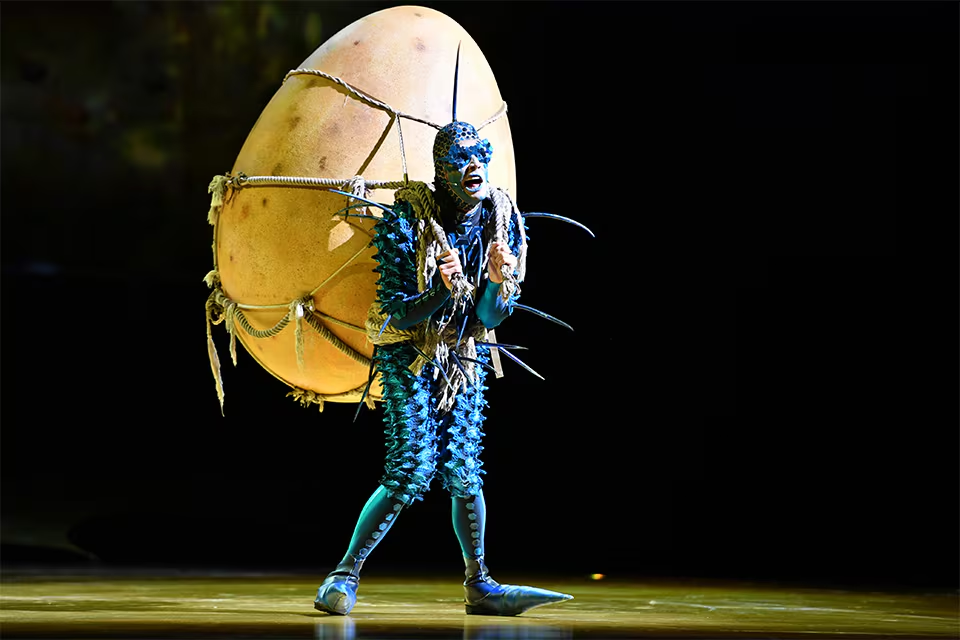
Insects can be elegant and extraordinary…and it all starts with an egg.

The Foreigner (Blue Fly) with a mysterious OVO (Egg). Photo credit Vlad Lorenzo courtesy of Cirque Du Soleil: OVO

Cirque du Soleil: OVO continues live and in person at the Agganis Arena in Boston, Massachusetts through Sunday, July 28 before continuing in at the Amica Mutual Pavilion in Providence, Rhode Island August 1 through 4 and then at the SNHU Arena in Manchester, New Hampshire August 8 through 11.  Click here for more information and for tickets.

Going behind the scenes at Cirque du Soleil: OVO, some intriguing facts were unveiled about how this tremendous production comes together.  From the preparation to the performers which includes two Olympians to Liz Vandal’s kaleidoscopic costumes from Montreal, this unique production is brought to life in distinctive venues all over the world.  The following are some amazing facts from Senior Publicist Janie Mallet of OVO:

  • Cirque du Soleil is celebrating its 40th anniversary!  OVO’s cast and crew is a multi-cultural group that has been traveling around the world since 2009.  A quick paced touring production, OVO has spent fifteen years on the road changing city or country every single week.  The show did break during the pandemic before returning in 2022 with a revamped production featuring new acts and new music.
  • ‘Ovo’ is Portuguese for ‘egg’.  The production starts when The Foreigner arrives at this new colony of insects with an egg on his back.  The show explores how we interact with one another and learn to accept and celebrate our differences.  There is a love story, curiosities, and a bit of a confrontation in a world likened to a Brazilian rainforest.
  • Not only does the production travel with a full gym backstage, but with a full time coach, access to nutritionists, two performance therapists, doctors and an artistic team of 100 people with 52 performing onstage.
  • The artists and athletes do their own cardio, strength training, and flexibility before attending meetings and trainings for the show.  The performers expend so much energy and do not follow a diet.  They eat what is best for them at their own discretion, but if they want to work on a specialized thing, they have three chefs and a catering team on hand.
  • The production has a lot of moving parts and the size and how the trucks are packed for the tours are different, especially if they fly across the ocean.  Everything is meticulously labeled and the teams need to be ready to adapt to any last minute changes.
  • The production has over 1000 costumes.  These costumes are built for the function of each performer and there are four full time technicians on tour to take care of the costumes.  All the costumes require some training in order to wear them comfortably.  The clowns have larger costumes while the crickets’ costumes are light and contain a lot of stretch for performing flips and jumps.  The aerial acts also have lighter costumes as they fly from one platform to the next.   
  • The production has six washers and three dryers that travel with them all over the world.  Delicate costumes and wardrobes are dried with the fans and 60 loads of laundry are completed prior to each performance.
The shoes
Washers and Dryers

Gary portrays Master Flipo, the chief of the insect colony.  Alongside Canadian poles artist acrobat David, they deliver some insight into their history in the circus, their favorite insects, and anticipating OVO’s opening night in Boston.  In real life, Gary is from Austria and lives in Spain. 

From L to R: David and Gary of OVO

Gary:  When I was 12, I decided I wanted to be a clown.  I told my mom and never lost this dream.  I ended up in a mime and circus school and then started to work in the circus before I joined Cirque de Soleil.  They said, ‘We like your stupid face’ in 1992.  I moved and did a show in Las Vegas and then back to Europe and then I’ve been here almost 7 years. 

David:  I started in the circus quite late at the age of 20.  Usually acrobats start at a much younger age with gymnastics but at 20, I started from nothing.  I saw a circus show and said that I want to do that and found out there were circus schools.  I didn’t know they existed in Quebec City so I trained really hard for two years to get in because I found out that there are people all over the world who are trying to enter these professional schools.  You need to already be good at something to get in and then somehow I got in.  I did my three years of circus school for like 40 hours a week of training.  Ever since, I’ve been in the circus and working with different circuses.  I’ve been with OVO since the re-launch in 2022 with new artists and music.  I’m part of the new acts. 

We are very excited about the show and don’t know how the public is going to react yet, but we’re all feeling super rested because we just came back from three weeks of tour break from home.  We’re very happy to be in Boston with the beautiful summer weather.  We’ve met Bostonians on the street and they seem very nice.

Gary:  Especially for us clowns it is very interesting in Boston to find out where they laugh and where they don’t laugh.  We have to adjust the timing and are already having butterflies. 

David:  We toured with the show everywhere in the world.  Depending on the different cultures, finding out how the audience will react is always our biggest concern.

Gary:  What I anticipate sharing with the audience the most is always taking people onstage.  Sometimes I have to improvise which I love and it challenges me.  Generally, the whole show is a big festival of happiness.  I don’t have favorites.

David:  I am excited about my act just because in the living arts and in the circus there is always a bit of modification.  It is never one stable show.  It is thousands of versions of the show, even though it’s the same show for the public.  For us, it has little changes and our act has new music, so we work on it frequently and make little changes in the choreography.  It’s going to be fresh, new and exciting. 

Gary:  I love the jeweled beetle so I love my colors. 

Gary as Jeweled Beetle Master Flipo Photo credit Vlad Lorenzo courtesy of Cirque du Soleil: OVO

David:  It’s a very beautiful insect.

Gary:  But at the same time, I love the ladybug. 

The Foreigner and The Ladybug Photo credit Pat Beaudry and courtesy of Cirque Du Soleil: OVO

David:  I really like the laced fly.  The lace fly is the hair extension act and I think her costume is just brilliant and so colorful.  It’s a beautiful act.

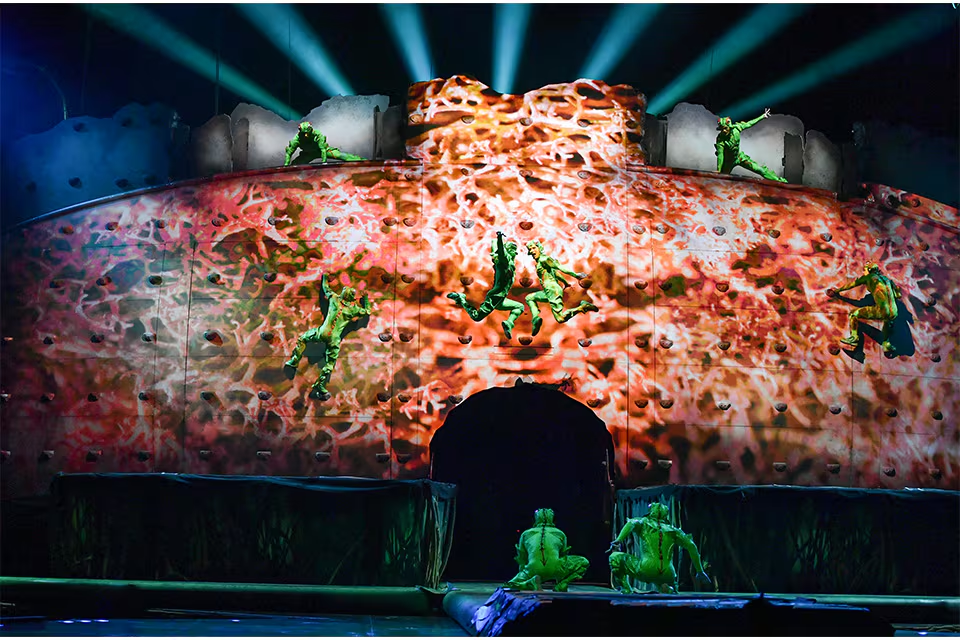
Gary:  I like the crickets for the costumes.  How they have an engineered costume where I always think, ‘How is it possible to move in that?’

The Crickets Wall Act Photo credit Vlad Lorenzo and courtesy of Cirque Du Soleil: OVO

David:  Shout out to the Red Queen.

The Red Queen with cast of ‘Cirque Du Soleil: OVO’ Photo courtesy of Cirque Du Soleil: OVO

Gary:  …and the clowns and the musicians. 

David:  OVO is really about inclusion.  It’s about accepting our differences and celebrating the whole of the colony, even the cockroaches.  They are all our friends.  It’s sort of hard to choose one specific insect because they are all amazing.

David:  The show takes years to train, but for this particular show, usually the creation of a Cirque de Soleil show is a few months.  Like six months maybe and because the acrobats have been thinking about the show for a year or two, the physical preparation to get to this level takes years and years of training.  Then we adapt the skills we have to the specific number and choreography that we need for the show, but it’s not like I train physically for years to be an insect.  I train physically to be a circus acrobat and artist and then transfer the skills in a few months. 

Gary:  It’s the same thing with us…the clowns.  We are being cast for that because our profile fits in it.  The clown has his own profile for performing and stupidity.  So I was cast because I am stupid and smart. 

David:  (laughs) Maybe that is also why I was cast.

Gary:  (laughs) Bingo!

The insects of ‘Cirque du Soleil: OVO’ Photo courtesy of Cirque du Soleil OVO

Cirque de Soleil: OVO continues live and in person at the Agganis Arena in Boston, Massachusetts through Sunday, July 28 before continuing in at the Amica Mutual Pavilion in Providence, Rhode Island August 1 through 4 and then at the SNHU Arena in Manchester, New Hampshire August 8 through 11.  Click here for more information and for tickets.

Company Theatre’s Director of Development Michael Hammond discusses returning to indoor theatre and the power of positivity to conquer your next audition

Michael Hammond may change the way you look at life.  Are you afraid of the audition?  He’ll show you a way to succeed.  Having a bad day?  He’ll show you a way to lift your spirits.  As the new Director of Development at the Company Theatre, a role he calls a lifelong dream, his positivity may help others the way Company Theatre has helped him since childhood. 

The Company Theatre, located at 30 Accord Park Drive in Norwell, Massachusetts, joyously held their first indoor production since their absorbing musical, Fun Home early last year.  Rock of Ages was an edgy and energetic rock jukebox musical that took place last month.  See Rock of Ages review here and click here for Sleepless Critic’s full podcast.

Sleepless Critic:  Please tell me what it was like to be back in the indoor setting for Rock of Ages

Michael Hammond: It’s so fantastic.  It’s emotional, exciting, and the energy in the air was just electric.  You were there.  You saw it.  People were cheering and screaming.

The show starts with Sally Forrest’s voice doing her standard announcement which we are all accustomed to hearing.  It was such a welcome back and to hear her voice and I think people cheered over her entire announcement.  Just to be back inside, hear that familiar voice, and to know we’re about to see a really fun and exciting show was just great.

SC:  I know this was the opening weekend for indoor theatre, but you did have some outdoor theatre experiences like Avenue Q before this show. 

MH:  Avenue Q was incredible.  The kids were so talented.  Their commitment to what they were doing and their characters were dynamic.  It was Broadway-type quality coming out of these kids on the outdoor stage of the Company Theatre out back.  We have had other things like Divas with a Twist and Donny Norton’s band, The New Band there.  That’s been a really nice addition to the Company Theatre as well as now being back inside.

SC:  So getting back to Rock of Ages, you had your opening weekend and you felt like everything went as smooth as can be?

MH:  Absolutely!  So many new people in this show and as is typical of the Company Theatre, they are already saying this is my new home.  It’s this overwhelming feeling that you’re home and you found your family at the Company Theatre even if you did one show and you never come back, it still feels that way.  I’ve been involved since I was 19 years old. 

Shane Hennessey as Stacee Jaxx Photo courtesy of Zoe Bradford/Company Theatre

SC:  I was going to say that you are familiar with that feeling.

MH:  I’m very familiar with that feeling.  I don’t know what my life would have been like without Company Theatre.  I would have taken a completely different path. 

SC:  It’s hard to replicate the kind of friendly and welcoming atmosphere you have when you’re in theatre.

MH:  Absolutely!  Such a nice group of people too that do theatre especially the teens.  They just stay out of trouble.  They have a common goal they are working towards and they enjoy each other’s company and make lifelong friendships.  I can’t say enough about it.

I’ve just seen so many kids, even this summer just come through the doors and they leave just completely changed and confident and more themselves.  It’s just a beautiful thing to witness.

SC:  When you said you had been with Company Theatre pretty much your whole life, you said it was a lifelong dream to do something like this as the Director of Development now.  I’m really excited for you.

MH:  Thank you!  Like a lot of people during the pandemic, you start to question ‘Am I doing what I want with my life?  Is this fulfilling and rewarding?’  Like many people, I came to the conclusion that what I was doing was not for me anymore. 

It had run its course and I needed something new and Jordie Saucerman, one of the founding partners of the Company Theatre, had passed away and that really accelerated my thought process because her wake was attended by so many people.  I thought ‘Look at all the lives that she touched.’  The impact that Jordie had on people is immeasurable.  Even if I make just a little sliver of that impact on people, I would feel great about my life.  That set the wheels turning. 

I approached Zoe one day and said, ‘I will be your janitor.  I basically don’t care what you have me do, if there is a spot for me here, I am coming.’  That seed was planted awhile ago and it sort of blossomed into Director of Development.  I’m so excited to try new things and just give back what I got from this theatre. 

SC:  Not only that, but you have a similar positive way about you like Jordie had.  Where do you get your positive outlook from?  Where do you draw it from considering I’ve also seen videos of you on social media?

I’m not attempting to fill Jordie’s shoes in any way.  That’s not a task that anyone could accomplish.  She is a unique individual who I feel is still around in the atmosphere and in the joy of the theatre.  If I’m upset or have a bad day, it makes me feel better to brighten someone else’s day.  That is such a nice feeling to buy someone in line a coffee or just compliment someone or encourage someone to do something they didn’t think they could do.  I live off of that.  If I am having the worst day of my life and I do something nice for somebody, I instantly feel recharged.  I think that’s how I basically go through life.

SC:  I hear that from a lot of comedians as well.  It makes them feel better to make someone else laugh even if they are upset or having issues.

MH:  I tried standup comedy once.  I did it more for the writing aspect, but I did perform.  It was an interesting experience because you come out onstage and you look at a sea of faces who want you to succeed because if you succeed, they have a fantastic time.  You have an overwhelming amount of support that you just want to hold onto and it was an incredible feeling.

SC:  What did you did before this that you wanted to walk away from and join the Company Theatre?

MH:  I was the station manager at a local cable television station.  I was so grateful because it was also a non-profit.  I probably learned so many skills that I could apply to this job I didn’t necessarily have before.  Just the behind the scenes stuff, the QuickBooks, the budgets, and managing a non-profit was extremely helpful and then also applying my video experience to the job as well.  Filming and creating events and learning special effects. 

So all of that which at the time was a perfect job for me, but nine years later I felt like I needed a change and so I am going to apply what I learned there and bring it to the Company Theatre.  We can offer acting for camera classes and improv for camera classes. 

I’ve been on auditions and in commercials.  We want to provide those skills to kids who like to act and be on camera.  We want them to be able to go into an audition and know how to slay what they are going to be asked to do and be prepared for anything.

I actually started with a class over the summer.  Some of the kids were auditioning so they got immediate training for those auditions. When they came back, they would tell the other students that they did just what Michael showed us.  I asked if they felt more prepared.  Did you do a better job with the audition?  Their faces lit up and they said, ‘Absolutely!’  That was a nice thing.

We want to get in touch with the local casting agencies which we already have a good relationship.  We want to create a talent database where you can see video auditions and we can send those out so we kind of want to be a bridge between the local movie and theatre scene.  We’ll provide students with the training.  They’ll have the skills to go out and nail professional auditions and maybe get cast in movies and commercials.  We just really want everyone to have new and exciting opportunities to excel in a career in film and theatre if that is something that they are interested in. 

‘Ragtime’ (L to R) Barbara Baumgarten, Cristian Sack, Hilary Goodnow, Brenna Kenney, Finn Clougherty, Jillian Griffin, with Hannah Dwyer as Little Girl and Michael Hammond as Tateh Photo courtesy of Zoe Bradford/Company Theatre

SC:  Let’s face it – the audition process is the most nerve-wracking and hardest part I think to convey right off the bat because in your head, you are saying,’ I know what I can do for you’ but then you get up there and it is not exactly what you picture. 

MH:  Having directed before, people come in and they are nervous. The reality is the casting company is nervous and they have roles to fill.  So, the second you come in, put them at ease, and they know they have options, they feel better.  I always say in my mind when I got into an audition, ‘Here I am!  You can relax.  I am going to be that person you need.’  I think it’s an interesting way to keep yourself calm to think I am exactly what you need instead of I hope I’m what you need.

SC:  I never really thought of it like that.

MH:  Think about it.  You have a reputation.  You have a project.  You want to cast the right people because that makes you look good as well.  If you find the right people not only are you confident about the project, but it brings excitement. 

When I direct a show, I’m not very excited about it until I know who is in it and then I can tailor their performances to their talents. It is such a thrill to watch people blossom. 

Please tell me about the projects you are working on now and upcoming projects.

I don’t think I’ll be directing anything for a little bit.  I’ll probably take on some projects here and there.  I definitely can’t leave that part behind.  I’m really going to focus on the video classes.  I’ll be working with Christie Reading.  She is extremely talented with anything video related.  So, I will be teaming up with her teaching improv for camera, acting for camera, and getting people ready for auditions. 

I think it will be really exciting if we get someone cast in a major motion picture which has happened at Company Theatre.  Andrew Mackin was in Mystic River, Jonathan Togo is on CSI, Michael Morlani is the casting director for Disney.  There are a lot of success stories that come out of this theatre. 

We want to nurture and encourage that.  That is kind of my goal.  It’s to really push people to excel in any way that they can.

SC: You can’t forget about Boston Casting.  How convenient is that!  There are all kinds of films going on in the state.

MH: Exactly and literally a mile down the road they are making motion pictures.  So how can we not be a part of that?  They are working on the new Jon Hamm movie in Cohasset.  I know Angela at Boston Casting who is an incredible woman and I don’t know how she does everything she does, but with all those films going on, eventually they will run out of actors. 

We get casting notices all the time and I’m forwarding them off to everybody I know that I think fits.  For example, I sent a buddy of mine a notice yesterday.  They were looking for an actual butcher with acting experience and I happen to know a butcher with acting experience.  I’m thinking he might get it.

SC: I know. Some of the requirements are so wild.

MH: It’s so specific, but every once in a while I’ll say, ‘Wait a minute, that is me.’ 

Company Theatre is offering theatre classes in the fall. Click here for the full schedule and upcoming events.